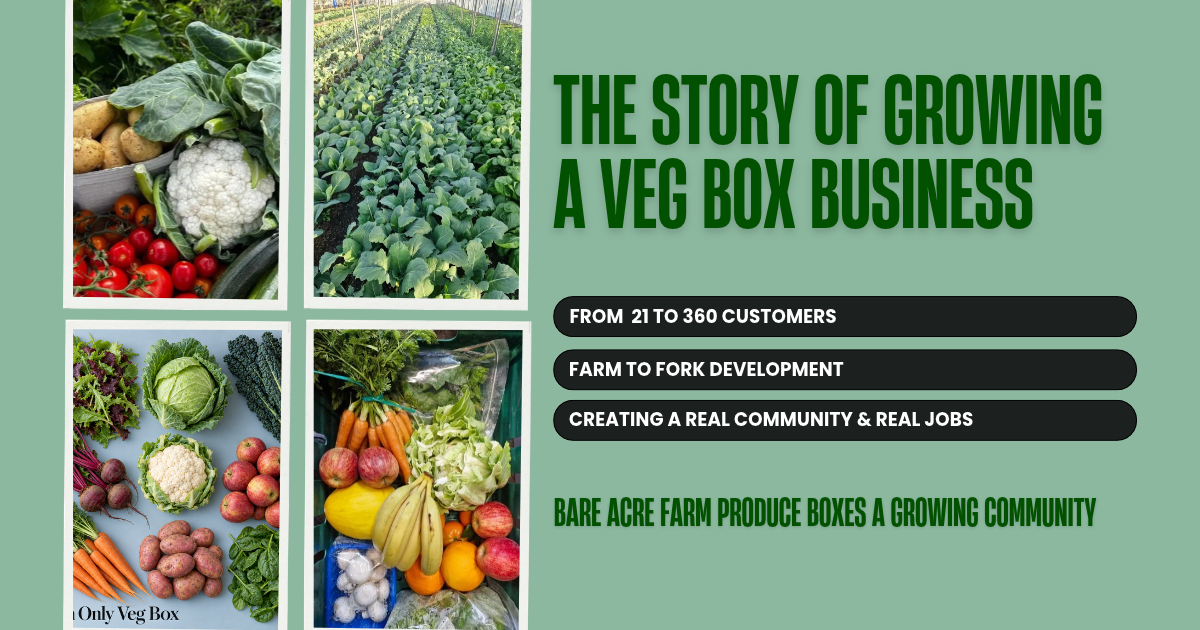
From 21 customers in our first week to 360 customers last week. Here’s why we do it, and where we hope to go next.
When we started packing and distributing Bare Acre Farm Boxes, the ambition was fairly straightforward. We wanted to grow good food, grow it sustainably, and sell it directly to the people who would eat it.
Simple enough in theory. In practice, as we’ve discovered, farming and selling what you grow are two very different challenges.
We started with a single acre, a farm shop, and the belief that there was a market for fresh, locally grown vegetables produced without the use of chemicals. We still believe that, but we’ve learned a great deal about how people shop, what they’re prepared to pay, and the importance of making good food both affordable and convenient.
Why vegetable boxes?
One of the biggest challenges facing small growers is price. Growing vegetables on a small scale is expensive, particularly when you’re trying to do it sustainably, pay people properly and invest in the land rather than simply extract as much as possible from it.
Selling through a farm shop is wonderful, but it comes with considerable overheads. By selling directly to customers through a weekly vegetable box scheme, we can plan our harvests, reduce waste, improve efficiency and keep our prices much closer to those people are accustomed to paying in supermarkets.
That was always the thinking behind our boxes. Not to create an expensive, exclusive organic food product, but to make locally grown, sustainably produced food accessible to more households.
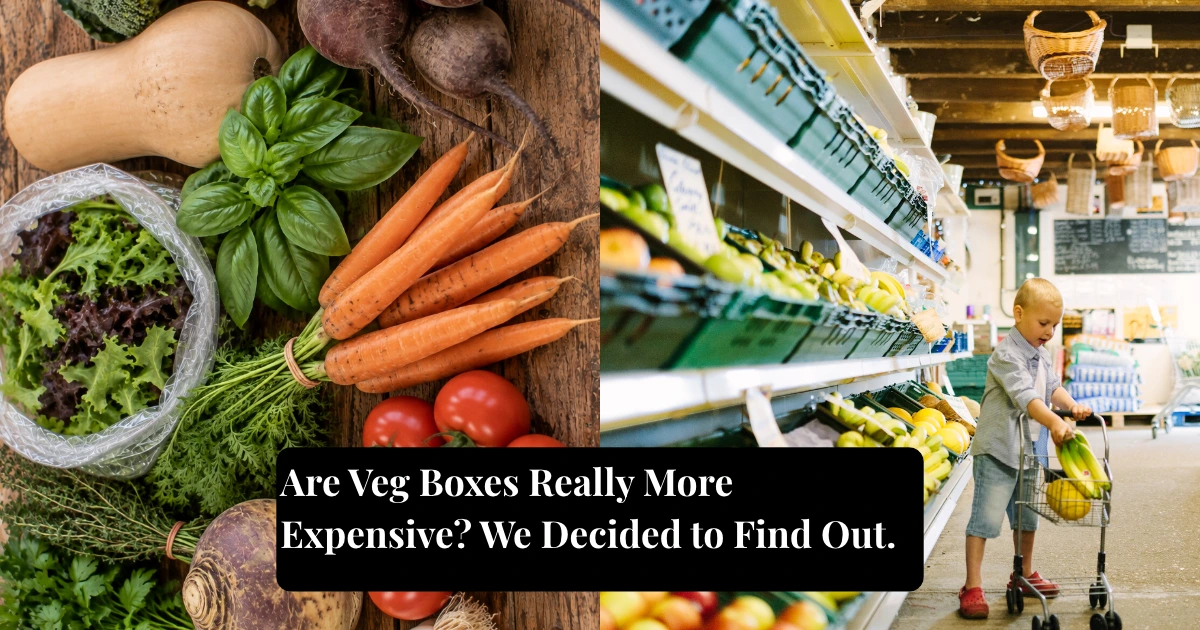
We wanted to challenge the perception that buying from a small farm was necessarily more expensive than shopping in a supermarket.
Growing our own and supporting other local growers.
From the beginning, we’ve been open about the fact that not everything in our boxes comes from Bare Acre Farm.
We grow as much as we reasonably can ourselves, using simple regenerative principles, but we’re not going to pretend we can produce every vegetable, every week of the year, on a small farm in North County Dublin.
So we work with other growers, predominantly local producers, to fill the gaps. We buy good-quality produce, pay growers their asking price and pay them promptly.
On average, depending on the season, between 65% & 80% of the produce we pack each week comes from our own farm. The balance comes from other growers and suppliers.
It’s a practical approach that gives our customers greater variety, helps us maintain a consistent supply and allows us to support other farming businesses along the way.
From 21 customers to 360.
Our first week of vegetable boxes went out to just 21 customers.
Last week, we had 360 customers on our books, with weekly sales currently running at between 140 and 170 boxes.
We’re pleased with that progress, although we’d be the first to admit it hasn’t all been plain sailing. We’ve made mistakes, changed systems, tried things that didn’t work and occasionally wondered whether we were making life unnecessarily difficult for ourselves.
But we’ve also listened to customers, and their feedback has shaped much of what we’ve done.
At the beginning of 2026, we introduced our Fruit Boxes and 50/50 Fruit & Veg Boxes, recognising that many households wanted more than just vegetables.
This October, we added a Soup Box and a Roast Box, again in response to customer requests. It’s a simple idea, more comfort foods are always welcome as we head into winter, so in hindsight, we should have recognised earlier the demand for these boxes.
Our range has developed because customers have told us what they want, rather than because we’ve decided what they ought to buy. We’ve always shaped our offering around our customers, around what they will eat and we’ve built exclusions into our boxes so customers are never faced with vegetables they just will not use.
More than just vegetables.
Another important development has been the introduction of additional products that customers can add to their weekly orders.
Free-range eggs, milk, Ber’s homemade breads and jams, locally produced honey, organic extra virgin olive oil and a growing selection of other foods are now available alongside our boxes.
For customers, it means being able to get more of their weekly shopping delivered together. For us, it creates an opportunity to work with other small food producers and offer their products to a wider audience.
And that’s an important part of where we want to take the business.
Growing the farm to grow the business.
Behind the scenes, the farm itself has changed considerably.
We’ve grown from our original single acre to approximately four acres, with significant investment in additional growing space, particularly glasshouses and polytunnels.
That investment hasn’t been made simply to grow more vegetables. It’s also about being able to grow more reliably.
If the past few years have taught us anything, it’s that the weather can no longer be taken for granted. Prolonged dry spells, excessive rainfall and increasingly unpredictable temperatures are making outdoor vegetable production more challenging.
Protected growing gives us greater control, extends our growing season and helps us maintain a more dependable supply of fresh produce.
It doesn’t eliminate the problems, and it certainly doesn’t come cheap, but we believe it’s essential if small farms like ours are to have a viable future.
So where do we go from here?
Our ambition is to develop Bare Acre into something approaching a full farm-to-fork grocery service.
Not a supermarket in the conventional sense, but a practical alternative for people who want to buy more of their food directly from farmers, growers and independent artisan producers.
We want customers to have genuine choice. To be able to order their vegetables, fruit, bread, eggs, preserves and other everyday foods together, knowing where much of that food comes from and that their money is supporting real producers rather than disappearing into the margins of a large retail chain.
We also want to make the service easier to use, more flexible and more competitive on price.
Our target for 2027 is 300 vegetable boxes per week. That’s ambitious, and getting there will require further investment, greater efficiency and, most importantly, a lot more customers.
But we’re not interested in growth simply for the sake of getting bigger.
We want to build a business that can pay its way, provide decent employment, support other local producers and give more households access to genuinely good food at a fair price.
There are easier ways to make a living than growing vegetables. We’ve had plenty of opportunities to reflect on that over the past couple of years.
But we still believe that small farms, working together with other local producers and selling directly to their communities, can play a much bigger part in how we feed ourselves.
Our vegetable boxes are our attempt to make that happen.
And to everyone who has ordered a box, recommended us to a friend, stuck with us when things went wrong or simply given us a chance, thank you.
We’re still a long way from where we want to be, but we’re a hell of a lot further along than we were when those first 21 boxes went out.
Dave & Ber
Bare Acre Farm
www.bareacrefarm.ie